PallasDB
PallasDB is a key-value database written in Go, built from first principles. It provides crash-safe persistence, sorted string tables, multi-level compaction, a SQL layer, gRPC transport, and Raft-backed replication.
What it is
At its core PallasDB is an LSM-tree storage engine layered with:
- A Write-Ahead Log (WAL) for crash safety
- SSTables (Sorted String Tables) for durable sorted storage
- A merge iterator that unifies multiple sorted levels into a single view
- An MVCC transaction model with snapshot isolation and conflict detection
- A recursive-descent SQL parser and expression evaluator
- A gRPC server for remote key-value access
- A Raft consensus layer (via HashiCorp Raft) for replicated, strongly-consistent writes
- Serf gossip for automatic cluster member discovery
Source layout
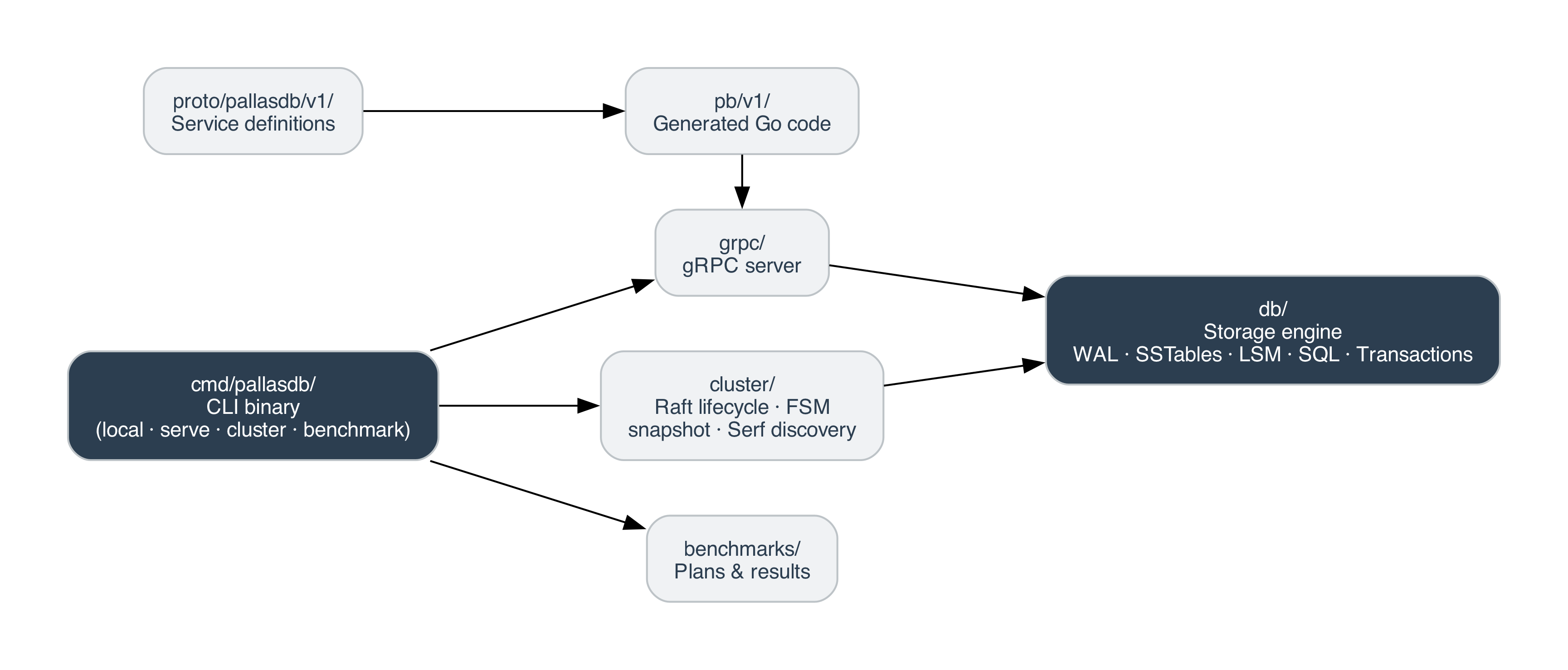
Design goals
- Crash-safe by default - every committed write is fsync'd before returning.
- Sorted access - all structures (memtable, SSTables, merge iterators) maintain lexicographic order, enabling efficient range scans.
- Strong consistency in cluster mode - all mutating operations route through the Raft leader; reads can be served locally.
- Self-contained binary - a single
pallasdbbinary covers local embed, standalone gRPC server, and full Raft cluster node.
Getting Started
Installation
Requires Go 1.25 or later.
git clone https://github.com/teddymalhan/pallasdb.git
cd pallasdb
go mod download
go build -o pallasdb ./cmd/pallasdb
Run the test suite:
go test ./...
Configuration
PallasDB reads configuration from three sources with the following precedence:
CLI flags > environment variables > config file > built-in defaults
Load an explicit config file:
pallasdb --config ./pallasdb.example.yaml serve grpc
Environment variables use the PALLASDB_ prefix; dots and dashes become underscores:
PALLASDB_LOG_FORMAT=json \
PALLASDB_SERVE_GRPC_ADDR=:50052 \
pallasdb serve grpc
Config key reference
| Config key | Env variable | Default | Description |
|---|---|---|---|
log.format | PALLASDB_LOG_FORMAT | text | Log handler format: text or json |
shutdown.timeout | PALLASDB_SHUTDOWN_TIMEOUT | 15s | Graceful shutdown timeout |
local.data_dir | PALLASDB_LOCAL_DATA_DIR | data | Data directory for local commands |
serve.grpc.addr | PALLASDB_SERVE_GRPC_ADDR | :50051 | Listen address for the gRPC server |
serve.grpc.data_dir | PALLASDB_SERVE_GRPC_DATA_DIR | data | Data directory for the gRPC server |
cluster.grpc_addr | PALLASDB_CLUSTER_GRPC_ADDR | :50051 | gRPC address advertised to peers |
cluster.data_dir | PALLASDB_CLUSTER_DATA_DIR | data | KV data directory for the cluster node |
cluster.raft_addr | PALLASDB_CLUSTER_RAFT_ADDR | :7001 | Raft TCP transport address |
cluster.raft_dir | PALLASDB_CLUSTER_RAFT_DIR | raft | Directory for Raft BoltDB log and snapshots |
cluster.node_id | PALLASDB_CLUSTER_NODE_ID | node-1 | Unique node identifier |
cluster.join | PALLASDB_CLUSTER_JOIN | "" | gRPC address of an existing node to join |
cluster.apply_timeout | PALLASDB_CLUSTER_APPLY_TIMEOUT | 10s | Raft apply timeout |
cluster.serf.enabled | PALLASDB_CLUSTER_SERF_ENABLED | true | Enable Serf gossip discovery |
cluster.serf.addr | PALLASDB_CLUSTER_SERF_ADDR | :7946 | Serf bind address |
cluster.serf.advertise_addr | PALLASDB_CLUSTER_SERF_ADVERTISE_ADDR | "" | Serf advertise address (for NAT) |
cluster.serf.join | PALLASDB_CLUSTER_SERF_JOIN | [] | Serf peers to join on startup |
cluster.serf.event_buffer | PALLASDB_CLUSTER_SERF_EVENT_BUFFER | 64 | Serf event channel buffer size |
Example YAML config
log:
  format: text

shutdown:
  timeout: 15s

local:
  data_dir: data

serve:
  grpc:
    addr: ":50051"
    data_dir: data

cluster:
  grpc_addr: ":50051"
  data_dir: data
  raft_addr: ":7001"
  raft_dir: raft
  node_id: node-1
  join: ""
  apply_timeout: 10s
  serf:
    enabled: true
    addr: ":7946"
    advertise_addr: ""
    join: []
    event_buffer: 64
CLI Reference
pallasdb local - local key-value operations
All local commands accept --data-dir to specify where data is stored.
# Insert or update a key
pallasdb local put <key> <value> --data-dir ./data

# Fetch a key
pallasdb local get <key> --data-dir ./data

# Scan a key range [start, stop]
pallasdb local range <start> <stop> --data-dir ./data

# Delete a key
pallasdb local delete <key> --data-dir ./data

# Trigger compaction
pallasdb local compact --data-dir ./data
pallasdb local benchmark - disk-backed benchmark
pallasdb local benchmark \
  --data-dir /tmp/bench \
  --reset \
  --keys 2000000 \
  --value-size 128 \
  --batch-size 1000 \
  --read-ops 500000 \
  --compact \
  --format text \
  --output results.txt
| Flag | Default | Description |
|---|---|---|
--data-dir | data | Benchmark data directory |
--reset | false | Wipe existing data before running |
--keys | 10000 | Number of keys to populate |
--value-size | 128 | Value size in bytes |
--key-size | 16 | Key size in bytes |
--batch-size | 500 | Keys written per transaction |
--read-ops | 10000 | Number of random-read operations |
--scan-limit | 0 | Number of keys to scan (0 = skip) |
--compact | false | Run explicit compaction after populate |
--format | text | Output format: text or json |
--output | "" | Write output to file instead of stdout |
pallasdb serve grpc - standalone gRPC server
pallasdb serve grpc --addr :50051 --data-dir ./data
pallasdb cluster start - Raft cluster node
Bootstrap the first node:
pallasdb cluster start \
  --node-id node-1 \
  --grpc-addr :50051 \
  --raft-addr :7001 \
  --serf-addr :7946 \
  --data-dir ./data/node-1 \
  --raft-dir ./raft/node-1
Join a running cluster via Serf gossip:
pallasdb cluster start \
  --node-id node-2 \
  --grpc-addr :50052 \
  --raft-addr :7002 \
  --serf-addr :7947 \
  --serf-join localhost:7946 \
  --data-dir ./data/node-2 \
  --raft-dir ./raft/node-2
Join explicitly via gRPC (no Serf):
pallasdb cluster start \
  --node-id node-2 \
  --grpc-addr :50052 \
  --raft-addr :7002 \
  --serf-enabled=false \
  --join localhost:50051 \
  --data-dir ./data/node-2 \
  --raft-dir ./raft/node-2
pallasdb completion - shell completions
pallasdb completion bash
pallasdb completion zsh
pallasdb completion fish
pallasdb completion powershell
pallasdb version
pallasdb version
# pallasdb dev
# commit: none
# built: unknown
Architecture Overview
PallasDB is structured as three independent layers that can be used separately or stacked together.
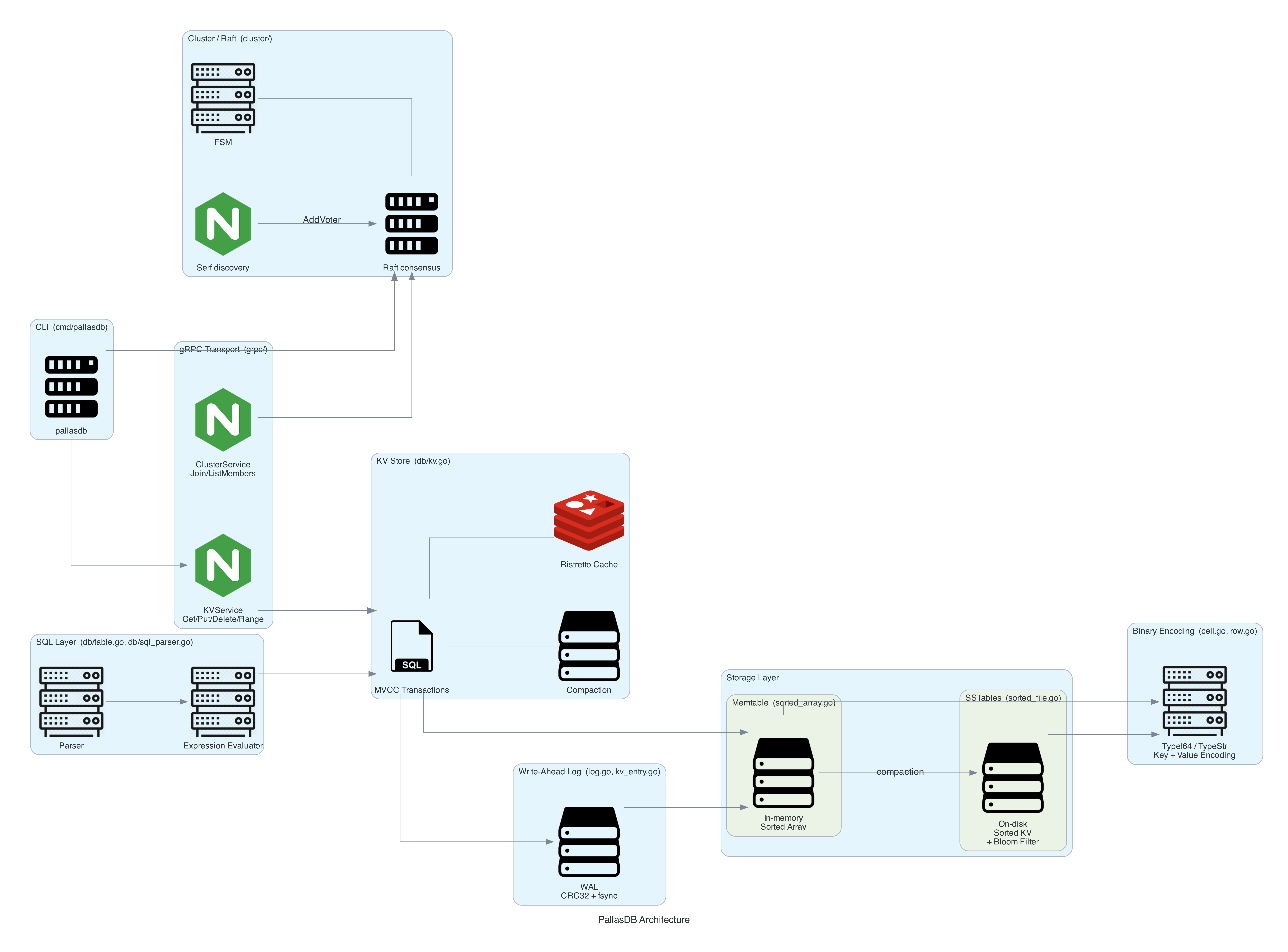
Data flow - write path
- Client calls
KV.Set(key, val)(or via gRPCPut, or SQLINSERT). - A transaction (
KVTX) is opened with a snapshot of the current state. - The mutation is staged in
tx.updates(aSortedArray). - On
Commit(): a. A conflict check compares updated keys against keys modified by concurrent transactions since this snapshot. b. Each mutation is appended to the WAL (Log.Write) as aEntryAddorEntryDelrecord. c. AEntryCommitrecord is written and fsync'd - the write is now durable. d. The transaction's updates are merged into the in-memory memtable (kv.mem). - If auto-compact is enabled, a compaction signal is sent on
kv.updated.
In cluster mode, mutating commands are first encoded as a Command protobuf, submitted to raft.Apply, and only reach the FSM's Apply() method after consensus. The FSM then calls db.KV.SetEx / db.KV.Del directly.
Data flow - read path
KV.Get(key)checks the optional Ristretto LRU cache first.- A transaction is opened, creating a
MergedSortedKVview spanning:tx.updates(pending mutations, if any)kv.mem(memtable snapshot)kv.main[0..n](SSTable snapshots, newest first)
- The merged view performs
getExact(key):- For
SortedArray: binary search on the in-memory key slice. - For
SortedFile: bloom filter pre-check, then binary search using the on-disk offset index.
- For
- The first level that returns
found=truewins; deleted markers suppress the result. - On cache miss the result is inserted into the Ristretto cache.
Compaction
Compaction has two sub-operations that are triggered by KV.Compact():
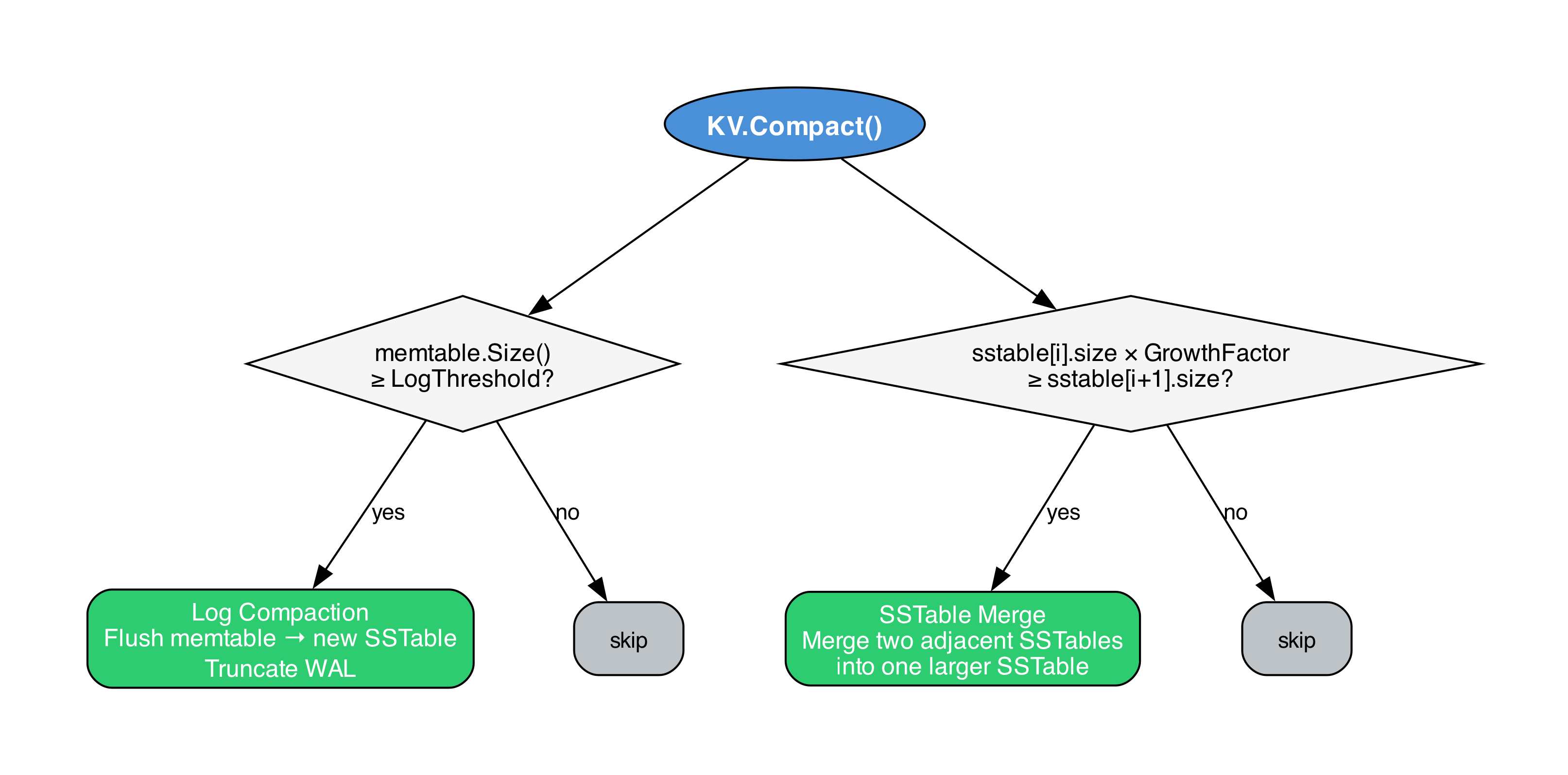
Both operations update the double-buffered metadata files atomically before closing old files.
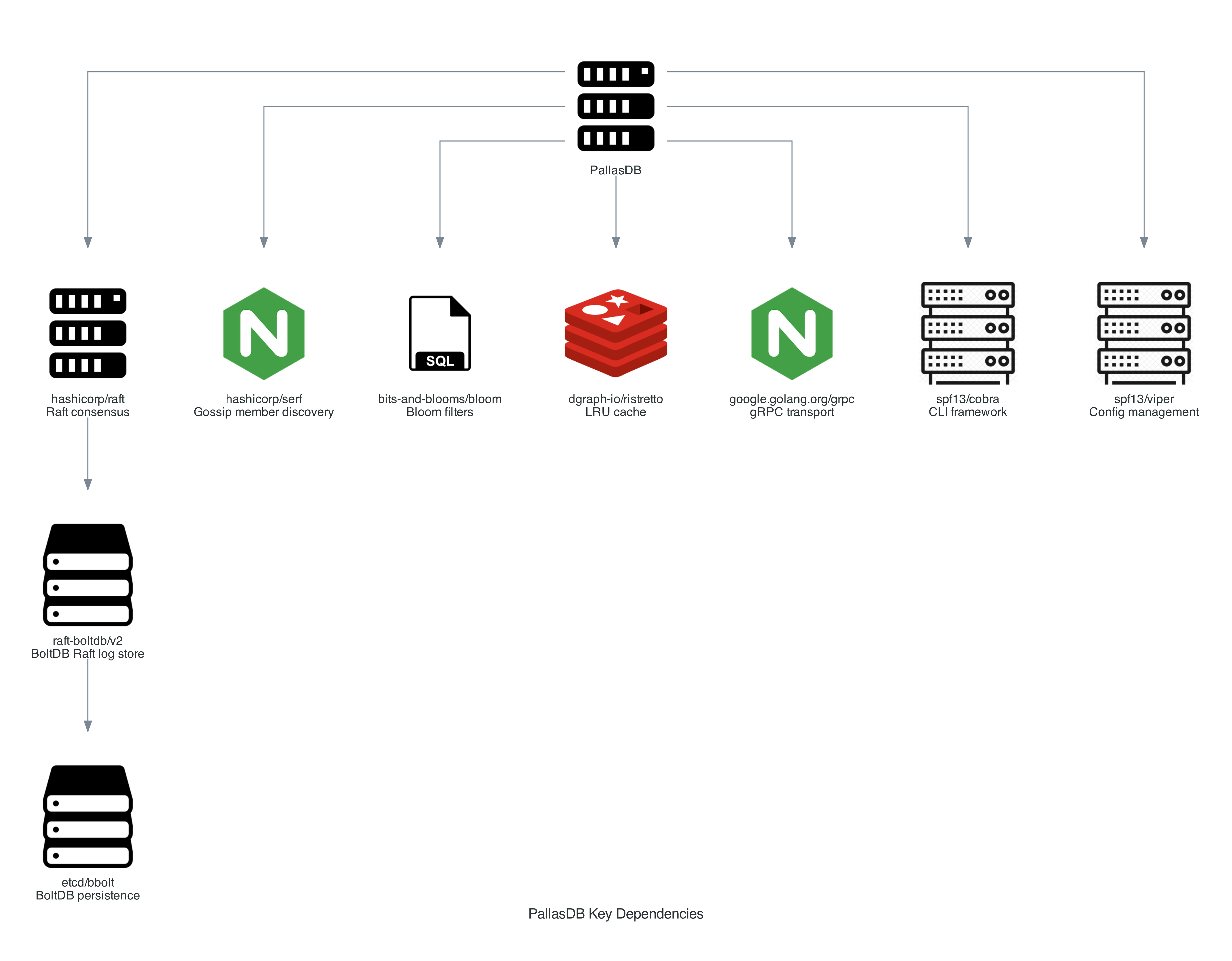
Key dependencies
Storage Engine
The storage engine lives entirely in db/. It is a classic LSM-tree (Log-Structured Merge-tree) with a custom binary encoding layer.
Components at a glance
| Component | File(s) | Role |
|---|---|---|
| Binary encoding | cell.go | Typed value encoding for keys and values |
| Row/schema encoding | row.go | Multi-column key and value encoding |
| Write-Ahead Log | log.go, kv_entry.go | Crash-safe mutation log |
| Memtable | sorted_array.go | In-memory sorted key-value buffer |
| SSTables | sorted_file.go | Immutable on-disk sorted key-value files |
| Merge iterator | merge.go | Multi-level sorted merge |
| KV store | kv.go | LSM engine: transactions, compaction, cache |
| Metadata | metadata.go | Double-buffered SSTable version tracking |
| SQL layer | sql_parser.go, eval.go, table.go | SQL parsing, expression evaluation, table ops |
On-disk layout
For a data directory ./data, PallasDB creates:
SSTable filenames are sstable_<version> where version is a monotonically increasing uint64 tracked in the metadata.
Data flow summary
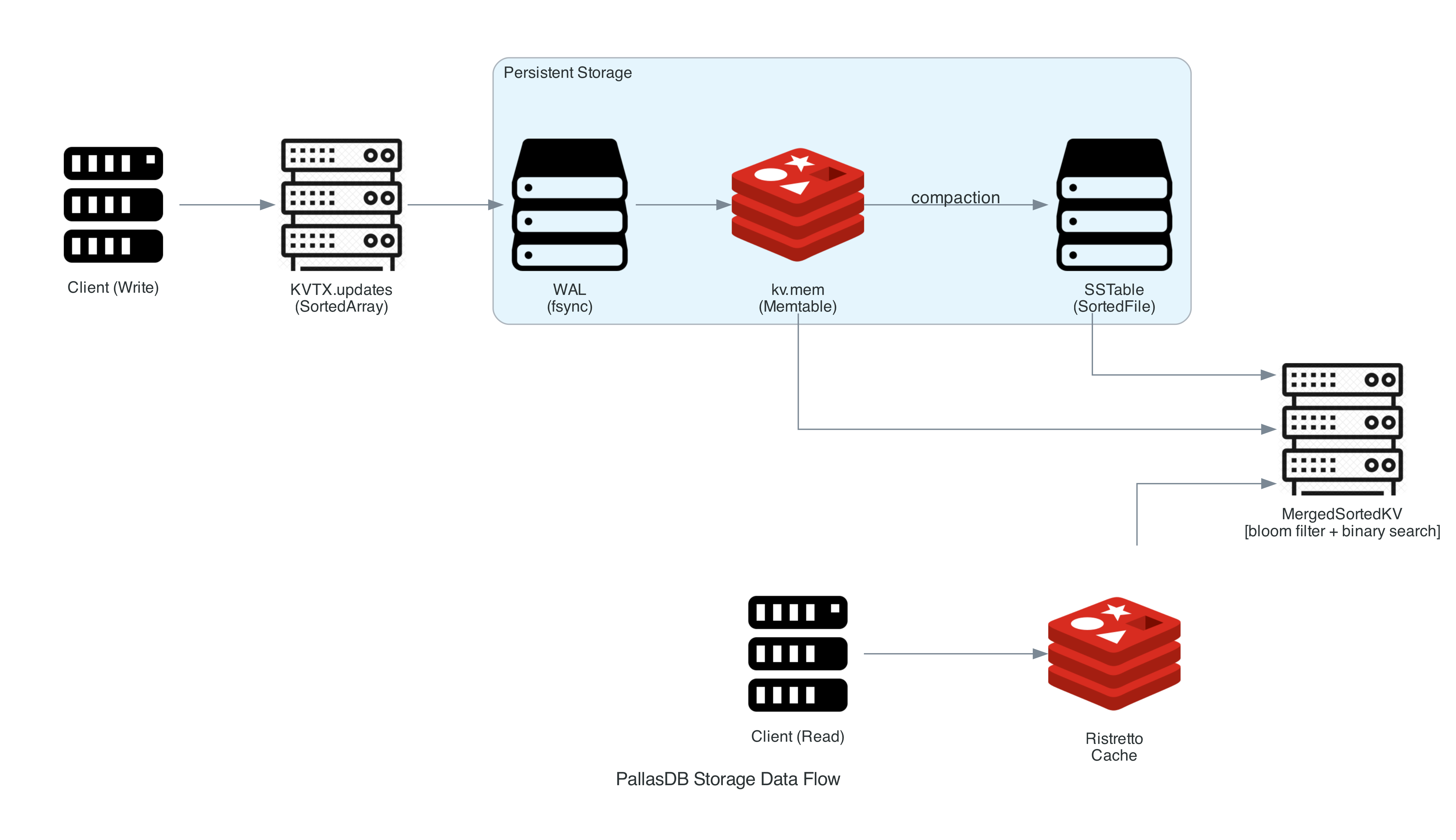
The sections below document each component in detail.
Cells and Rows
Source: db/cell.go, db/row.go
PallasDB's lowest encoding layer provides two abstractions: Cell (a single typed value) and Row (an ordered collection of Cells).
Cell
A Cell holds one of two types:
type CellType uint8

const (
    TypeI64 CellType = 1  // int64
    TypeStr CellType = 2  // []byte (variable-length string)
)

type Cell struct {
    Type CellType
    I64  int64
    Str  []byte
}
Key encoding
Keys must sort correctly when compared as raw bytes. PallasDB encodes each type differently:
TypeI64 - big-endian with sign bit flipped:
uint64(i64) XOR (1 << 63) → 8 bytes, big-endian
The XOR flips the sign bit so that negative integers sort before positive integers in unsigned byte order (e.g., -1 sorts before 0).
TypeStr - null-terminated with escape sequences:
| Input byte | Encoded bytes |
|---|---|
0x00 | 0x01 0x01 |
0x01 | 0x01 0x02 |
| other | byte unchanged |
| end-of-string | 0x00 |
This scheme preserves lexicographic order and allows variable-length strings to be compared without knowing their length in advance.
Value encoding
Values do not need to sort, so a simpler encoding is used:
TypeI64 - 8 bytes, little-endian.
TypeStr - 4-byte little-endian length prefix followed by the raw bytes.
Row
A Row is a []Cell whose length matches the schema's column count.
type Schema struct {
    Table   string
    Cols    []Column    // column definitions
    Indices [][]int     // each index is a list of column positions
}

type Column struct {
    Name string
    Type CellType
}
Key encoding for rows
[table_name] 0x00 [index_number(1 byte)]
  [type_byte(1)] [encoded_cell] ...  (for each indexed column)
0x00
The table name prefix and index number isolate keys for different tables and different indices in the same KV namespace.
Value encoding for rows
Only non-primary-key columns are stored in the value. Primary key columns are already encoded in the key. Each non-PK column appends its EncodeVal output in column order.
Index keys
Secondary indices encode the indexed columns plus the primary key columns (to keep keys unique). The value for a secondary index entry is empty - the primary key is already in the key itself, so a secondary index lookup requires a follow-up primary key lookup to fetch the full row.
Example
For a schema with columns (id int64, name string) and primary key (id):
Key:   "users" 0x00 0x00  TypeI64 [big-endian id ^ sign]  0x00
Value: [4-byte length] [name bytes]
A secondary index on (name, id) would produce:
Key:   "users" 0x00 0x01  TypeStr [escaped name bytes] 0x00  TypeI64 [big-endian id ^ sign]  0x00
Value: (empty)
Write-Ahead Log (WAL)
Source: db/log.go, db/kv_entry.go
The Write-Ahead Log (WAL) provides crash-safe persistence. Every committed transaction is written and fsync'd to the WAL before the in-memory state is updated. On restart, PallasDB replays all committed entries to reconstruct the memtable.
Log entries
Each WAL record is a single Entry:
type EntryOp uint8

const (
    EntryAdd    EntryOp = 0  // set key → value
    EntryDel    EntryOp = 1  // delete key
    EntryCommit EntryOp = 2  // transaction boundary
)

type Entry struct {
    key []byte
    val []byte
    op  EntryOp
}
Wire format
Each entry is encoded as:
[4 bytes] CRC32-IEEE checksum of everything after these 4 bytes
[4 bytes] key length (little-endian uint32)
[4 bytes] value length (little-endian uint32)
[1 byte]  op (EntryAdd=0, EntryDel=1, EntryCommit=2)
[key len] key bytes
[val len] value bytes
The CRC32 checksum covers all bytes starting from the key-length field. An EntryCommit record has zero-length key and value. The maximum entry size is 64 MiB.
Transaction protocol
A single transaction writes:
EntryAdd  key=k1  val=v1
EntryDel  key=k2  val=nil
EntryAdd  key=k3  val=v3
EntryCommit
The Commit() call:
- Writes the
EntryCommitrecord. - Calls
file.Sync()- the writes are now durable. - Advances
writer.committedto the current offset.
If the process crashes before Sync() returns, the uncommitted records are ignored on recovery because the commit marker was never persisted.
ResetTX() rolls back an uncommitted transaction by resetting the write offset to writer.committed, overwriting any partially written records on the next write.
Recovery on startup
openLog() in kv.go:
- Reads entries sequentially from offset 0.
- Accumulates
EntryAdd/EntryDelrecords in a buffer. - On
EntryCommit, records the committed count. - On EOF, bad checksum, or truncated read, stops - only committed entries survive.
- Sorts the committed entries by key (stable sort), then replays them into the memtable, deduplicating by keeping the last write per key.
Log truncation
When the memtable is compacted into an SSTable (compactLog()), the WAL is truncated to zero with file.Truncate(0). The SSTable now contains the durable representation of what was in the log.
File management
The WAL file is created via createFileSync which opens with O_CREATE | O_RDWR and calls Sync() after creation to ensure the directory entry is durable. Reads use ReadAt (positioned reads) via OffsetReader, avoiding seek races when reading and writing concurrently.
Sorted Array (Memtable)
Source: db/sorted_array.go
The memtable is an in-memory sorted key-value store backed by three parallel slices. It is the mutable hot tier of the LSM tree - all committed writes land here before being compacted to disk.
Data structure
type SortedArray struct {
    keys    [][]byte
    vals    [][]byte
    deleted []bool
}
The three slices are kept in strict lexicographic key order. A deleted=true entry is a tombstone - it records that a key was deleted without removing it from the array, so that merging with older SSTables correctly shadows the older value.
Interface
SortedArray implements the SortedKV interface:
type SortedKV interface {
    EstimatedSize() int
    Iter() (SortedKVIter, error)
    Seek(key []byte) (SortedKVIter, error)
}
And additionally implements sortedKVExactGetter for O(log n) point lookups without creating a full iterator.
Key operations
| Method | Complexity | Notes |
|---|---|---|
Set(key, val) | O(log n) search + O(n) insert | slices.BinarySearchFunc + slices.Insert |
Del(key) | O(log n) search + O(n) insert | Marks existing entry as deleted, or inserts tombstone |
getExact(key) | O(log n) | Binary search, returns (val, found, deleted) |
Seek(key) | O(log n) | Returns iterator positioned at or after key |
Iter() | O(1) | Iterator starting at position 0 |
Iterator
SortedArrayIter holds a snapshot of the slice headers at creation time. It supports Next() and Prev() for bidirectional iteration.
Fast-path append during commit
When committing a transaction and there are no concurrent transactions, appendSortedArray is attempted first:
// If all keys in src sort after all keys in dst, just append.
if dst.Size() != 0 && bytes.Compare(dst.keys[last], src.keys[0]) >= 0 {
    return false  // fall back to merge
}
dst.keys = append(dst.keys, src.keys...)
// ...
This is a common case for sequential key populations and avoids the O(n) merge path.
Merge into memtable
When the fast-path append is not safe (e.g., overlapping key ranges or concurrent transactions), the commit merges the transaction updates with the current memtable using MergedSortedKV:
merged := SortedArray{}
iter, _ := MergedSortedKV{&tx.updates, &kv.mem}.Iter()
for ; iter.Valid(); iter.Next() {
    merged.Push(iter.Key(), iter.Val(), iter.Deleted())
}
kv.mem = merged
The merge iterator gives priority to the first (newer) level, so transaction updates shadow older memtable entries.
SSTables (Sorted String Tables)
Source: db/sorted_file.go
SSTables are immutable, on-disk sorted key-value files. They represent the durable tier of the LSM tree. Once written, an SSTable is never modified - compaction merges multiple SSTables into a new one and then deletes the old files.
File format
Byte offset 0:
  [8 bytes]   nkeys  (little-endian uint64) - number of entries

Bytes 8 to 8 + nkeys*8:
  [8 bytes each]  entry offsets (little-endian uint64)
                  offsetIndex[i] = file offset of entry i

Entry at offset[i]:
  [4 bytes]  key length (little-endian uint32)
  [4 bytes]  value length (little-endian uint32)
  [1 byte]   deleted flag (0 = live, 1 = tombstone)
  [key len]  key bytes
  [val len]  value bytes

After all entries:
  [bloom len bytes]  marshaled bloom filter
  [8 bytes]          bloom filter byte length (little-endian uint64)
  [8 bytes]          magic: 'P' 'D' 'B' 'B' 'L' 'M' '1' '\n'
The file starts with an offset index - one 8-byte file offset per entry - enabling O(1) random access to any entry given its position. The maximum supported keys per file is 1 << 26 (~67 million).
The offset index is loaded into memory (file.offsetIndex) during Open() if it fits within 64 MiB. For larger files the offset index falls back to an individual ReadAt per lookup.
Bloom filter
Each SSTable embeds a Bloom filter (github.com/bits-and-blooms/bloom/v3) at the end of the file:
- False positive rate: 1% (
sortedFileBloomFalsePositiveRate = 0.01) - Keys are added during
writeSortedFile - On
Open(), the bloom filter is deserialized from the file footer - Before any binary search,
mayContainKey(key)is called - if the bloom filter definitively says the key is absent, the binary search is skipped entirely
This is critical for performance: a Get for a key that does not exist in a given SSTable requires only a bloom filter check (a few memory accesses) rather than a full binary search with disk reads.
Seeking and binary search
findPos(target) performs a binary search using compareKeyAt(mid, target):
- Computes the file offset of entry
mid(from the in-memory offset index or aReadAt). - Reads only the key header + key bytes (not the value).
- Compares with
bytes.Compare(target, key).
This means values are never read during binary search - only keys. This optimization significantly reduces I/O for large values.
findPosExact(target) returns (pos, found, error) and is used for exact-match Get operations.
Seek(key) returns an iterator positioned at or after key.
Reading values separately
valueAt(pos) reads only the value (and deleted flag) for a given position, by:
- Looking up the file offset via the offset index.
- Reading the header to get
klenandvlen. - Seeking past the key bytes to read only the value.
This is used in getExact after a successful binary search - the key comparison during search never touches value bytes.
Writing an SSTable
CreateFromSorted(kv SortedKV) writes a new SSTable from any SortedKV source:
- Pre-allocates an offset index slot for each estimated key.
- Iterates the source, writing each entry and recording its offset.
- After all entries, writes the final
nkeyscount at offset 0. - Appends the bloom filter and its footer.
- Calls
file.Sync()to ensure durability before the caller updates metadata.
Limits
| Constant | Value | Description |
|---|---|---|
maxNKeys | 67,108,864 | Maximum keys per SSTable |
sortedFileBloomFalsePositiveRate | 0.01 | 1% bloom filter false positive rate |
sortedFileMaxOffsetIndexBytes | 64 MiB | Maximum offset index loaded into RAM |
maxEntrySize | 64 MiB | Maximum combined key+value size |
LSM Tree & Compaction
Source: db/kv.go, db/merge.go
PallasDB's storage engine is an LSM-tree (Log-Structured Merge-tree). Writes go to an in-memory memtable (backed by a WAL) and are periodically flushed and merged to disk as SSTables.
Levels
The LSM structure has a flat list of levels:
Level 0: kv.mem      (SortedArray - in-memory, mutable)
Level 1: kv.main[0]  (SortedFile - newest SSTable)
Level 2: kv.main[1]  (SortedFile)
...
Level N: kv.main[N-1] (SortedFile - oldest SSTable)
A read must check all levels in order (newest first) because a newer level may contain an update or deletion that shadows an older entry.
Merge iterator
MergedSortedKV unifies multiple SortedKV sources into a single sorted stream:
type MergedSortedKV []SortedKV
MergedSortedKVIter maintains one iterator per level and at each step selects the level with the lexicographically smallest current key. On Next(), only levels that are at or behind the current key are advanced.
For point lookups (getExact), MergedSortedKV short-circuits: it queries each level in order and returns the first hit, so lower (older) levels are not accessed if an upper level has the key.
Compaction triggers
KV.Compact() is called:
- Explicitly via
pallasdb local compact - Automatically after each commit when
AutoCompact=true(via a background goroutine) - Automatically after each gRPC write in
serve grpcmode
func (kv *KV) Compact() error {
    if memSize >= kv.Options.LogThreshold {
        return kv.compactLog()   // flush memtable → new SSTable
    }
    for i := 0; i < len(kv.main)-1; i++ {
        if kv.shouldMerge(i) {
            return kv.compactSSTable(i)  // merge two adjacent SSTables
        }
    }
    return nil
}
Log compaction (memtable flush)
Triggered when memtable.Size() >= LogThreshold (default: 1,000 entries).
- Increment
kv.version, compute SSTable filenamesstable_<version>. - Write the memtable as a new
SortedFileatkv.main[0]position.- If this is not the last SSTable level, tombstones are preserved (older levels may have live entries that need to be hidden).
- If it would be the only SSTable, tombstones are stripped (
NoDeletedSortedKVwrapper).
- Atomically update metadata: prepend the new SSTable name to the list.
- Insert the new
SortedFileat position 0 inkv.main. - Clear the memtable and truncate the WAL.
SSTable merge
Triggered when sstable[i].EstimatedSize() * GrowthFactor >= sstable[i+1].EstimatedSize().
The default GrowthFactor is 2.0, implementing a 2× size ratio between adjacent levels - similar to LevelDB's tiered compaction.
- Merge
kv.main[i]andkv.main[i+1]usingMergedSortedKV. - Write the merged result as a new
SortedFile.- If the two files are the last in
kv.main, tombstones are stripped.
- If the two files are the last in
- Update metadata atomically.
- Close and delete the two old SSTable files.
- Replace the two entries in
kv.mainwith the single new file.
Growth factor and compaction policy
With GrowthFactor=2.0:
Level 1: ~1,000 entries  (log threshold)
Level 2: ~2,000 entries  (after first merge: 1+2)
Level 3: ~4,000 entries
Level 4: ~8,000 entries
...
Each compaction at level i merges levels i and i+1, producing a file roughly 2× the size. This bounds the total number of levels to O(log N) for N total entries.
Tombstone garbage collection
Tombstones (deleted=true entries) are only safe to remove when they are in the last (oldest) SSTable level. If a tombstone were removed from a non-bottom level, an older SSTable might surface the deleted entry.
NoDeletedSortedKV is applied as a wrapper around the source when writing the bottom level SSTable:
type NoDeletedSortedKV struct{ SortedKV }

func (kv NoDeletedSortedKV) Iter() (SortedKVIter, error) {
    iter, _ := kv.SortedKV.Iter()
    return NoDeletedIter{iter}, nil  // skips tombstones
}
Options
| Option | Default | Description |
|---|---|---|
LogThreshold | 1,000 | Memtable entry count before flush |
GrowthFactor | 2.0 | Size ratio threshold for SSTable merge |
AutoCompact | false | Run compaction in background after every write |
CacheEnabled | false | Enable Ristretto LRU read cache |
CacheMaxCost | 0 | Maximum cache size in bytes |
CacheNumCounters | 0 | Ristretto counter slots (typically 10× max cached items) |
Metadata Management
Source: db/metadata.go
The metadata subsystem tracks which SSTable files currently make up the persistent storage. It uses a double-buffered write strategy to guarantee that a metadata update is either fully applied or fully absent - never partially written - even if the process crashes mid-write.
Data model
type KVMetaData struct {
    Version  uint64   // monotonically increasing, identifies the current generation
    SSTables []string // ordered list of SSTable filenames, newest first
}
Version starts at 0 and increments on every compaction. SSTable filenames are relative to the data directory (e.g., "sstable_7").
Double-buffered files
Two metadata files (meta0, meta1) are maintained. At any point, the file with the higher Version is the authoritative current state:
func (meta *KVMetaStore) current() int {
    if meta.slots[0].data.Version > meta.slots[1].data.Version {
        return 0
    }
    return 1
}
Write protocol
Set(data):
- Determine the current slot (
c). - Write
datato the other slot (1-c). - Update the in-memory state of that slot.
The current slot is never overwritten until the new slot has been successfully fsynced. This means:
- If a crash occurs during step 2, the current slot is still valid.
- After recovery,
current()returns the slot with the higher version, which is always a consistent state.
Metadata file format
Each metadata file holds:
[4 bytes]  CRC32-IEEE checksum of bytes 4 onward
[4 bytes]  JSON payload length (little-endian uint32)
[N bytes]  JSON-encoded KVMetaData
On read, if the checksum does not match or the file is too short, KVMetaData{} (zero value with Version=0) is returned - this is treated as an empty/uninitialized slot.
Integration with compaction
During compactLog() (memtable flush):
meta := kv.meta.Get()            // read current metadata
meta.Version = kv.version        // increment version
meta.SSTables = slices.Insert(meta.SSTables, 0, sstable)  // prepend new SSTable
kv.meta.Set(meta)                // write to the other slot (fsynced)
During compactSSTable(level) (SSTable merge):
meta.SSTables = slices.Replace(meta.SSTables, level, level+2, sstable)
kv.meta.Set(meta)
Both operations complete atomically from the metadata perspective: the old SSTable names are still referenced until meta.Set succeeds, so the data files are not deleted until after the metadata update.
Recovery on startup
openSSTable() calls kv.meta.Get() to find the current SSTable list, then opens each file in order. If a file listed in metadata does not exist on disk, Open() returns an error.
Transactions
Source: db/kv.go
PallasDB implements snapshot-isolated, optimistic MVCC transactions. Each transaction sees a consistent snapshot of the store at the time it was opened. Concurrent transactions can proceed in parallel; conflicts are detected only at commit time.
Transaction types
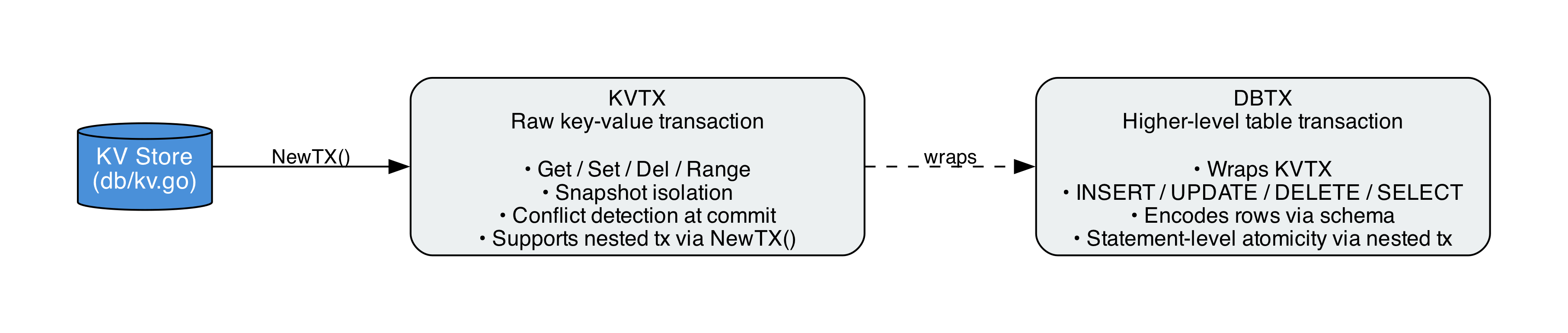
Both types support nested transactions: tx.NewTX() creates a child transaction whose updates are applied to the parent on commit rather than directly to the store.
Opening a transaction
tx := kv.NewTX()
NewTX() under kv.mu:
- Takes a snapshot of
kv.snapshot(a monotonically increasing counter). - Copies the memtable reference and SSTable list (copy-on-read - the slices are shared but immutable from the transaction's perspective).
- Constructs a
MergedSortedKVview:[tx.updates, memtable_snapshot, sstable_0, ...] - Registers the transaction in
kv.ongoing.
Reading in a transaction
val, ok, err := tx.Get(key)
Delegates to tx.levels.getExact(key) which scans levels newest-first. Tombstones (deleted=true) cause ok=false. The result reflects the state at the snapshot time plus any updates staged in tx.updates.
Range scans:
iter, err := tx.Range(start, stop, descending)
Returns a RangedKVIter that stops when the key moves past stop (ascending) or before stop (descending). Tombstones are filtered by NoDeletedIter.
Writing in a transaction
tx.Set(key, val)          // upsert
tx.SetEx(key, val, mode)  // ModeInsert, ModeUpdate, or ModeUpsert
tx.Del(key)               // delete (stages a tombstone)
All mutations go into tx.updates (a SortedArray) and are invisible to other transactions until Commit().
Committing
err := tx.Commit()
Under kv.commit (a separate mutex from kv.mu):
-
Conflict check - if
tx.updatesis non-empty, compare each updated key againstkv.history. If any key was updated by another transaction after this transaction's snapshot, returnErrTXConflict. -
WAL write - iterate
tx.updates, write oneEntryAddorEntryDelper key, then writeEntryCommitand callSync(). -
Memtable update (under
kv.mu):- Fast path: if no other transactions are open, try
appendSortedArray(O(1) if updates sort after existing keys). - Merge path: build a new merged
SortedArrayfromMergedSortedKV{tx.updates, kv.mem}.
- Fast path: if no other transactions are open, try
-
History update - increment
kv.snapshotand record updated keys inkv.history(if other transactions are open and might conflict).
Conflict detection
kv.history is a log of (snapshot, key) pairs for every key written since the oldest open transaction's snapshot:
type UpdatedKey struct {
    snapshot uint64
    key      []byte
}
A conflict occurs if any key in tx.updates appears in kv.history with a snapshot newer than tx.snapshot. This is a write-write conflict: another transaction committed a write to the same key after this transaction read it.
kv.history is pruned when transactions close: entries older than the oldest open transaction's snapshot are removed, as they can no longer cause conflicts.
Aborting
tx.Abort()
Removes the transaction from kv.ongoing and prunes kv.history. No WAL entry is written. The staged tx.updates are discarded.
Nested transactions
tx.NewTX() creates an inner transaction whose levels include the parent's tx.updates at the front:
inner := &KVTX{target: tx}
inner.levels = slices.Concat(MergedSortedKV{&inner.updates}, tx.levels)
On inner.Commit(), the inner updates are merged into tx.updates (not written to the WAL). On inner.Abort(), the inner updates are silently dropped. This is used by the SQL layer to implement statement-level atomicity within a larger transaction.
Synchronization
| Mutex | Protects |
|---|---|
kv.mu | kv.mem, kv.main, kv.snapshot, kv.history, kv.ongoing |
kv.commit | Serializes the WAL write + memtable update sequence |
kv.commit is held for the duration of the write pipeline, ensuring WAL entries are appended in commit order. kv.mu is held only briefly to update in-memory state after the WAL write completes.
UpdateMode
SetEx and KV.SetEx accept an UpdateMode:
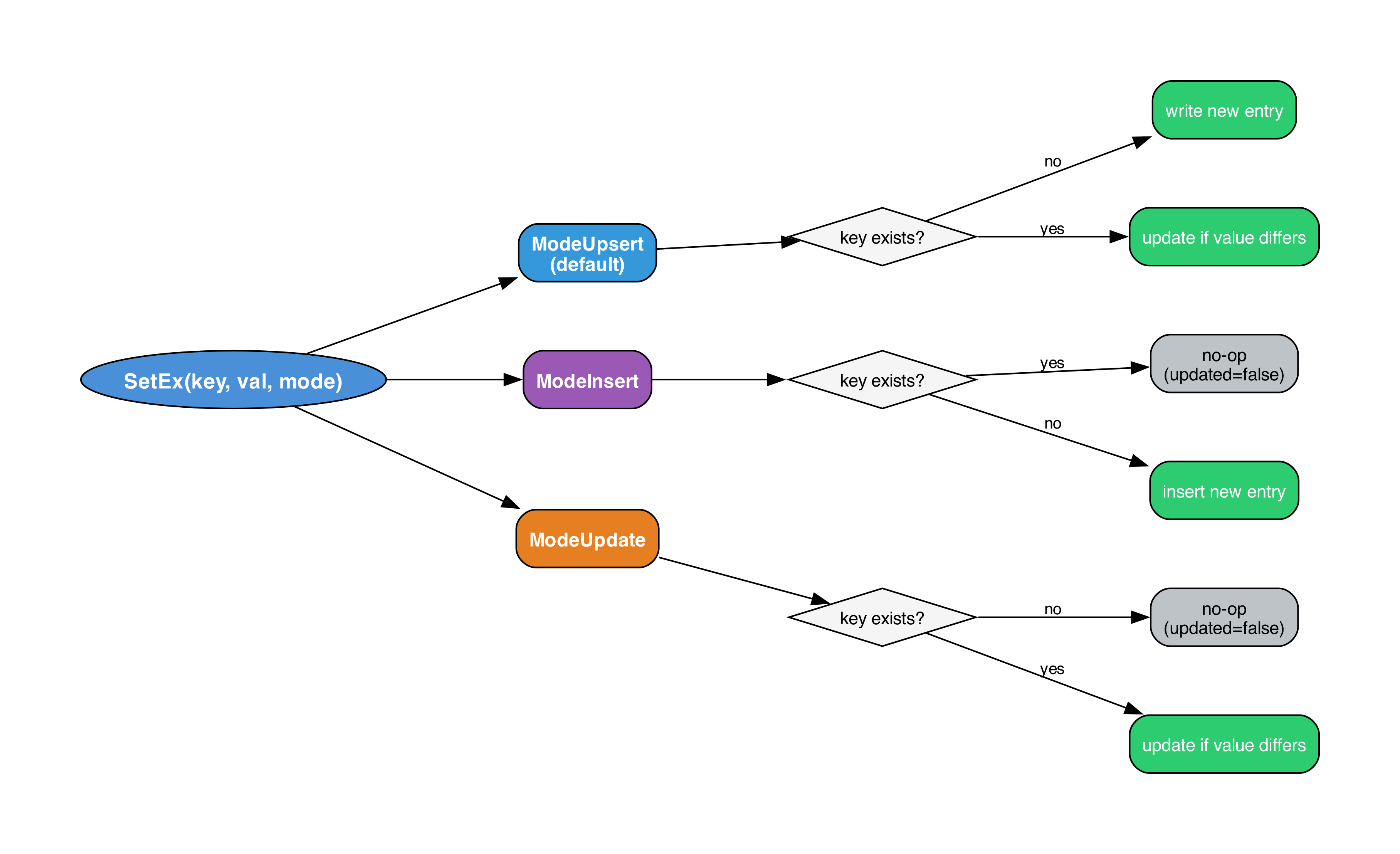
If the mode's precondition is not met, updated=false is returned and no WAL entry is written.
SQL Parser & Evaluator
Source: db/sql_parser.go, db/eval.go, db/table.go
PallasDB includes a hand-written recursive-descent SQL parser and expression evaluator. The SQL layer runs on top of the KV store and uses the DB / DBTX types to manage schemas and data.
Supported statements
| Statement | Syntax |
|---|---|
CREATE TABLE | CREATE TABLE name (col type, ..., PRIMARY KEY (cols), INDEX (cols)); |
SELECT | SELECT expr, ... FROM table WHERE cond; |
INSERT INTO | INSERT INTO table VALUES (val, ...); |
UPDATE | UPDATE table SET col = expr, ... WHERE cond; |
DELETE FROM | DELETE FROM table WHERE cond; |
Column types: int64, string.
Parser
Parser is a struct holding the input string and current position:
type Parser struct {
    buf   string
    pos   int
    depth int  // guards against deeply nested expressions
}
NewParser(s string) creates a parser. parseStmt() dispatches to the appropriate parse function based on the first keyword.
Token model
The parser does not produce a separate token stream - it operates directly on the input string with helper methods:
tryKeyword(kws ...string)- case-insensitive keyword match (requires separator after)tryPunctuation(tok string)- exact string matchtryName()- identifier: starts with letter or_, continues with[a-zA-Z0-9_]parseValue(out *Cell)- integer or string literal
Expression grammar
expr   ::= or
or     ::= and ("OR" and)*
and    ::= not ("AND" not)*
not    ::= "NOT" not | cmp
cmp    ::= add (("=" | "!=" | "<>" | "<=" | ">=" | "<" | ">") add)*
add    ::= mul (("+" | "-") mul)*
mul    ::= neg (("*" | "/") neg)*
neg    ::= "-" neg | atom
atom   ::= "(" expr ")" | name | value
The maximum expression depth is 1,000 (maxExprDepth) to prevent stack overflow from deeply nested NOT or negation chains.
AST nodes
type ExprBinOp struct { op ExprOp; left, right any }
type ExprUnOp  struct { op ExprOp; kid any }
type ExprTuple struct { kids []any }
// leaf nodes: string (column name) or *Cell (literal value)
Operators:
| Constant | Symbol |
|---|---|
OP_ADD | + |
OP_SUB | - |
OP_MUL | * |
OP_DIV | / |
OP_EQ | = |
OP_NE | !=, <> |
OP_LE | <= |
OP_GE | >= |
OP_LT | < |
OP_GT | > |
OP_AND | AND |
OP_OR | OR |
OP_NOT | NOT |
OP_NEG | unary - |
Expression evaluator
evalExpr(schema *Schema, row Row, expr any) (*Cell, error) evaluates an AST node against a row:
- String (column name) - looks up the column index in the schema and returns the cell from the row.
*Cell(literal) - returns the literal directly.ExprUnOp- appliesOP_NEG(negate integer) orOP_NOT(boolean not).ExprBinOp- evaluates both sides and applies the operator.
Arithmetic operations (+, -, *, /) require both sides to be TypeI64. Division by zero returns an error.
Comparison operations support both TypeI64 and TypeStr. Comparing different types returns an error.
Logical operators (AND, OR) work on TypeI64 values: 0 is false, anything else is true.
Schema management
Schemas are stored as JSON-encoded Schema values in the KV store under the key @schema_<table>:
val, _ := json.Marshal(schema)
tx.kv.Set([]byte("@schema_"+table), val)
GetSchema(table) checks a per-transaction cache (tx.tables) first, then falls back to a KV lookup. This avoids repeated schema deserialization within a transaction.
WHERE clause optimization
The SQL executor does not use a full-table scan. Instead, makeRange(schema, cond) analyzes the WHERE clause and attempts to convert it into a RangeReq:
-
Point lookup: if the WHERE is a conjunction of
col = literalequalities that exactly matches the primary key columns, produces a single-key range[pk, pk]. -
Range scan: if the WHERE is a comparison (
<,<=,>,>=) or a conjunction of two opposite comparisons on a primary-key prefix, produces a bounded range scan. Secondary indices are also tried. -
Unimplemented: if neither pattern matches, returns
"unimplemented WHERE". Full table scans are not supported.
This design means SQL queries must always be anchored to an index - a WHERE clause that cannot be resolved to an index range is rejected.
Table operations
DBTX wraps KVTX and adds schema-aware methods:
| Method | Description |
|---|---|
Insert(schema, row) | Insert a row; fails if primary key already exists |
Upsert(schema, row) | Insert or update |
Update(schema, row) | Update; no-op if row does not exist |
Delete(schema, row) | Delete all index entries for the row |
Select(schema, row) | Fetch a row by its primary key fields |
Seek(schema, row) | Return a forward iterator starting at the given primary key |
Range(schema, req) | Return a range iterator using a RangeReq |
All mutating operations maintain secondary indices: an update first deletes all existing index entries (using the old values), then inserts new ones.
Executing SQL
p := db.NewParser("SELECT id, name FROM users WHERE id >= 1 AND id <= 100;")
stmt, err := p.parseStmt()
result, err := dbHandle.ExecStmt(stmt)
ExecStmt wraps the execution in a transaction. SQLResult contains:
type SQLResult struct {
    Updated int    // rows affected (INSERT/UPDATE/DELETE)
    Header  []string // column names (SELECT)
    Values  []Row    // result rows (SELECT)
}
gRPC API
Source: grpc/server.go, grpc/cluster_server.go, proto/pallasdb/v1/kv.proto
PallasDB exposes its key-value store and cluster management over gRPC using Protocol Buffers v3.
Services
service KVService {
  rpc Get(GetRequest) returns (GetResponse);
  rpc Put(PutRequest) returns (PutResponse);
  rpc Delete(DeleteRequest) returns (DeleteResponse);
  rpc Range(RangeRequest) returns (stream RangeResponse);
}

service ClusterService {
  rpc Join(JoinRequest) returns (JoinResponse);
  rpc ListMembers(ListMembersRequest) returns (ListMembersResponse);
  rpc GetLeader(GetLeaderRequest) returns (GetLeaderResponse);
}
KVService
Get
message GetRequest  { bytes key = 1; }
message GetResponse { bytes value = 1; }
Fetches the value for key. Returns codes.NotFound if the key does not exist. Returns codes.InvalidArgument if key is empty.
Put
enum PutMode {
  PUT_MODE_UNSPECIFIED = 0;  // treated as UPSERT
  PUT_MODE_UPSERT = 1;
  PUT_MODE_INSERT = 2;
  PUT_MODE_UPDATE = 3;
}

message PutRequest  { bytes key = 1; bytes value = 2; PutMode mode = 3; }
message PutResponse { bool updated = 1; }
Inserts or updates key according to mode:
| Mode | Behavior |
|---|---|
UPSERT / UNSPECIFIED | Create or overwrite |
INSERT | Only create; no-op if key exists |
UPDATE | Only update; no-op if key does not exist |
updated=true if the store was actually modified.
Delete
message DeleteRequest  { bytes key = 1; }
message DeleteResponse { bool deleted = 1; }
Deletes key. Returns codes.NotFound if the key does not exist.
Range (server-streaming)
message RangeRequest  { bytes start = 1; bytes stop = 2; bool descending = 3; }
message RangeResponse { bytes key = 1; bytes value = 2; }
Streams all live key-value pairs in [start, stop] (ascending) or [stop, start] (descending). Both start and stop are required. The stream ends when the key range is exhausted or the client cancels.
ClusterService
Join
message JoinRequest  { string node_id = 1; string raft_addr = 2; }
message JoinResponse {}
Called by a new node to register itself with the leader. The leader calls raft.AddVoter to add the joining node to the Raft configuration.
ListMembers
message ListMembersResponse {
  repeated ClusterMember members = 1;
}

message ClusterMember {
  string node_id = 1;
  string grpc_addr = 2;
  string raft_addr = 3;
  string serf_addr = 4;
  ClusterMemberStatus status = 5;
  bool raft_voter = 6;
  bool leader = 7;
}
Returns all known cluster members, merging information from both Raft's server list and Serf's member list.
GetLeader
message GetLeaderResponse { string node_id = 1; string raft_addr = 2; }
Returns the current Raft leader's node ID and Raft transport address.
Server implementation
KVServer
KVServer in grpc/server.go wraps a *db.KV and implements KVServiceServer.
For Get / Put / Delete, the flow is:
- Validate that
keyis non-empty. - Check
ctx.Err()(cancelled/deadline exceeded). - Call the corresponding
db.KVmethod. - Map errors to gRPC status codes.
For Range, a transaction is opened (store.NewTX()) and held for the duration of the stream. The transaction provides a point-in-time consistent view of the store.
Health check
NewGRPCServer also registers the standard gRPC health service (grpc/health/grpc_health_v1):
healthSrv := health.NewServer()
healthSrv.SetServingStatus("", healthpb.HealthCheckResponse_SERVING)
Logging interceptor
LoggingUnaryInterceptor is available for unary RPCs. It logs the method name, gRPC status code, and duration using log/slog.
srv := grpcapi.NewGRPCServer(store, grpc.ChainUnaryInterceptor(
    grpcapi.LoggingUnaryInterceptor(logger),
))
Graceful shutdown
Serve(ctx, lis, srv) blocks until ctx is cancelled. On cancellation, GracefulStop is called with a 15-second timeout. If graceful stop does not complete within the timeout, srv.Stop() is called.
Regenerating protobuf code
go install github.com/bufbuild/buf/cmd/buf@latest
go install google.golang.org/protobuf/cmd/protoc-gen-go@latest
go install google.golang.org/grpc/cmd/protoc-gen-go-grpc@latest
buf generate
The buf.yaml and buf.gen.yaml in the repository root configure the buf toolchain.
Cluster & Raft
Source: cluster/node.go, cluster/fsm.go, cluster/fsm_snapshot.go, cluster/command.go, cluster/discovery/serf.go
PallasDB's cluster mode provides strongly-consistent replicated writes using the HashiCorp Raft library. Member discovery uses Serf gossip.
Architecture
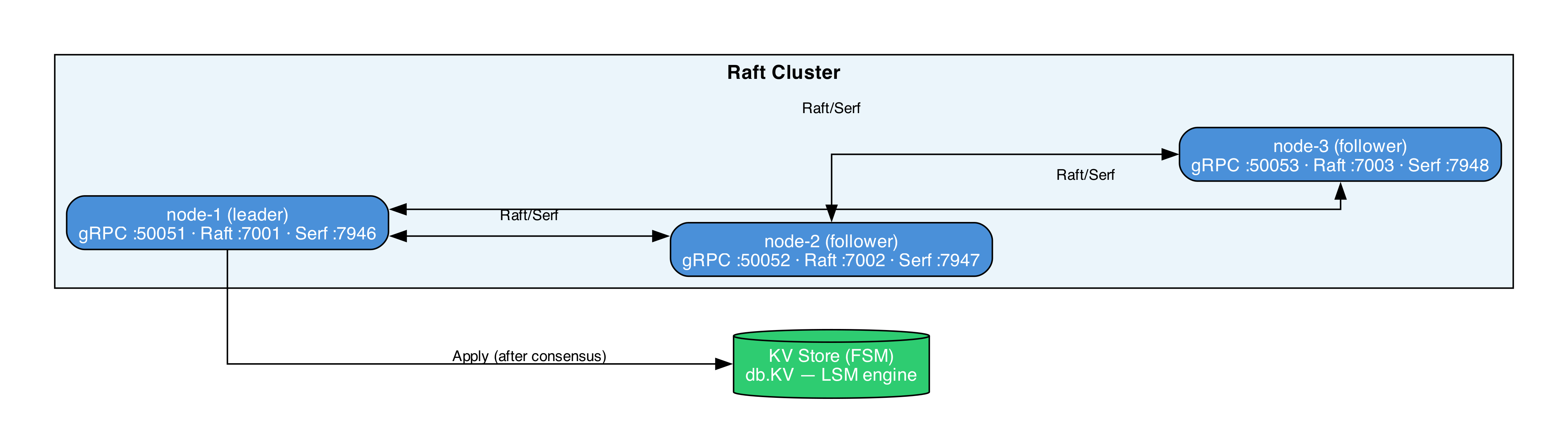
All mutating writes (Put, Delete) go through the Raft leader. Reads can be served locally from any node's FSM state (eventual consistency for reads, strong consistency for writes).
Node lifecycle
cluster.Open(kvStore, cfg)
- Creates the Raft data directory (
cfg.RaftDir). - Configures the Raft instance with
cfg.NodeIDas the local server ID. - Opens a TCP transport on
cfg.RaftAddr. - Opens a BoltDB store at
cfg.RaftDir/raft.db(with a 5-second file lock timeout to avoid blocking on a crashed predecessor). - Creates a file-based snapshot store (keeps 2 snapshots).
- Creates the FSM wrapping
kvStore. - Starts the
raft.Raftinstance. - If
cfg.Bootstrap=true, bootstraps the cluster with this node as the sole voter. - If
cfg.SerfEnabled=true, starts Serf and begins handling discovery events. - If
cfg.JoinAddr != "", sends a gRPCJoinrequest to the existing cluster.
Node.Shutdown()
- Stops Serf (if enabled).
- Shuts down the Raft instance.
- Closes the TCP transport.
- Closes the BoltDB store.
Finite State Machine (FSM)
FSM implements raft.FSM and wraps *db.KV with a sync.RWMutex to allow atomic state replacement during Restore.
Apply(log *raft.Log) interface{}
Called by Raft after a log entry is committed to a quorum. The entry is decoded as a Command:
type Command struct {
    Op   OpType      // OpPut or OpDel
    Key  []byte
    Val  []byte
    Mode uint8       // maps to db.UpdateMode
}
OpPut→store.SetEx(key, val, mode)OpDel→store.Del(key)
Returns *FSMResult{Updated: bool, Err: error}. The caller (cluster gRPC server) surfaces the error to the client.
Snapshot() (raft.FSMSnapshot, error)
Calls store.IterAll() to get a consistent point-in-time iterator. The iterator and its cleanup function are passed to FSMSnapshot, which streams all key-value pairs to the snapshot sink.
Restore(rc io.ReadCloser) error
Atomically replaces the entire FSM state:
- Reads all
(key, val)pairs from the snapshot stream. - Opens a fresh
db.KVat a temp directory (dirpath + ".restore"). - Writes all pairs to the fresh store.
- Under
f.mu.Lock():- Closes the existing store.
- Removes the old data directory.
- Renames the temp directory to
dirpath. - Opens a new
db.KVfromdirpath.
- The entire directory swap is the atomic unit.
Serf discovery
cluster/discovery/serf.go wraps the Serf library for automatic peer discovery:
type Config struct {
    NodeID            string
    GRPCAddr          string  // advertised in member metadata
    RaftAddr          string  // advertised in member metadata
    SerfAddr          string  // bind address
    SerfAdvertiseAddr string  // for NAT traversal
    JoinAddrs         []string
    EventBuffer       int
}
Each Serf member advertises its NodeID, GRPCAddr, and RaftAddr as member tags.
When a EventMemberJoin or EventMemberUpdate event is received and this node is the Raft leader, Node.addDiscoveredVoter calls n.raft.AddVoter(member.NodeID, member.RaftAddr). This means new nodes can join a cluster automatically without knowing the leader's address - they only need to know any existing Serf member's address.
SerfDiscovery.Members()
Returns []NodeInfo with the current known members, their gRPC and Raft addresses, and their Serf status.
Join via gRPC
When cfg.JoinAddr is set (and Serf is not handling join automatically), a gRPC Join request is sent to the target:
client.Join(ctx, &pbv1.JoinRequest{NodeId: nodeID, RaftAddr: raftAddr})
The target calls node.AddVoter(nodeID, raftAddr) on the Raft leader. If the target is not the leader, the Join call will still work as long as the target can forward or the caller retries.
Write path in cluster mode
The cluster gRPC server (grpc/cluster_server.go) intercepts Put and Delete:
- Encodes the operation as a
Command. - Calls
raft.Apply(encodedCommand, timeout). - Waits for the future to resolve (consensus reached and FSM applied on the leader).
- Extracts
*FSMResultfrom the future's response. - Returns the result to the caller.
If the node is not the leader, raft.ErrNotLeader is returned and the client should retry against the leader.
Configuration reference
| Field | Default | Description |
|---|---|---|
NodeID | required | Unique identifier for this node |
GRPCAddr | required | gRPC listen address, advertised via Serf |
RaftAddr | required | Raft TCP transport address |
RaftDir | required | Directory for BoltDB and snapshots |
Bootstrap | false | Bootstrap this node as the first in the cluster |
JoinAddr | "" | gRPC address of an existing node to join |
Timeout | 10s | Raft apply timeout |
SerfEnabled | true | Start Serf gossip for automatic discovery |
SerfAddr | :7946 | Serf bind address |
SerfAdvertiseAddr | "" | Serf advertise address (NAT) |
SerfJoinAddrs | [] | Serf addresses of existing members |
SerfEventBuffer | 64 | Serf event channel capacity |
Go API Reference
Import path: github.com/teddymalhan/pallasdb/db
KV - key-value store
Opening a store
kv, err := db.NewKV("path/to/data",
    db.WithLogThreshold(2000),
    db.WithGrowthFactor(2.0),
    db.WithAutoCompact(true),
    db.WithCache(64<<20, 640000),  // 64 MiB cache, 640k counters
)
if err != nil {
    log.Fatal(err)
}
defer kv.Close()
Options
| Function | Default | Description |
|---|---|---|
WithLogThreshold(n int) | 1000 | Memtable entry count before flush to SSTable |
WithGrowthFactor(f float32) | 2.0 | Size ratio threshold for SSTable merge (minimum 2.0) |
WithAutoCompact(enabled bool) | false | Run compaction in a background goroutine after every write |
WithCache(maxCostBytes, numCounters int64) | disabled | Enable Ristretto LRU read cache |
Point operations
// Get
val, ok, err := kv.Get([]byte("hello"))

// Set (upsert)
updated, err := kv.Set([]byte("hello"), []byte("world"))

// SetEx - explicit mode
updated, err := kv.SetEx([]byte("hello"), []byte("world"), db.ModeInsert)
updated, err := kv.SetEx([]byte("hello"), []byte("world"), db.ModeUpdate)
updated, err := kv.SetEx([]byte("hello"), []byte("world"), db.ModeUpsert)

// Delete
deleted, err := kv.Del([]byte("hello"))
Iteration
// Iterate all live keys
iter, cleanup, err := kv.IterAll()
defer cleanup()
for ; iter.Valid(); iter.Next() {
    fmt.Printf("%s = %s\n", iter.Key(), iter.Val())
}
Compaction
err := kv.Compact()
Flushes the memtable if it exceeds the threshold and merges adjacent SSTables if the size ratio triggers. Safe to call concurrently with reads and writes.
Close
err := kv.Close()
Waits for background goroutines (compaction thread, open transactions), closes the cache, and closes all open files.
KVTX - key-value transaction
tx := kv.NewTX()
defer tx.Abort()  // no-op if already committed

// Read
val, ok, err := tx.Get([]byte("key"))

// Write
updated, err := tx.Set([]byte("key"), []byte("val"))
updated, err := tx.SetEx([]byte("key"), []byte("val"), db.ModeInsert)
deleted, err := tx.Del([]byte("key"))

// Range scan
iter, err := tx.Range([]byte("a"), []byte("z"), false /* ascending */)
for ; iter.Valid(); iter.Next() {
    fmt.Printf("%s\n", iter.Key())
}

// Seek
iter, err := tx.Seek([]byte("prefix"))

// Commit
if err := tx.Commit(); err == db.ErrTXConflict {
    // retry
}
Nested transactions:
inner := tx.NewTX()
inner.Set(...)
inner.Commit()  // merges into parent tx.updates, not the store
DB - higher-level table database
DB wraps KV and adds schema management and SQL execution.
Opening
d, err := db.NewDB("path/to/data")
defer d.Close()
NewDB accepts the same KVOption functions as NewKV.
Schema definition
schema := &db.Schema{
    Table: "users",
    Cols: []db.Column{
        {Name: "id",   Type: db.TypeI64},
        {Name: "name", Type: db.TypeStr},
        {Name: "age",  Type: db.TypeI64},
    },
    Indices: [][]int{
        {0},    // primary key: id
        {2, 0}, // secondary index: (age, id)
    },
}
Row operations
row := schema.NewRow()
row[0] = db.Cell{Type: db.TypeI64, I64: 42}
row[1] = db.Cell{Type: db.TypeStr, Str: []byte("alice")}
row[2] = db.Cell{Type: db.TypeI64, I64: 30}

tx := d.NewTX()
defer tx.Abort()

updated, err := tx.Insert(schema, row)   // fails if id=42 exists
updated, err := tx.Upsert(schema, row)   // create or replace
updated, err := tx.Update(schema, row)   // fails if id=42 absent
deleted, err := tx.Delete(schema, row)   // deletes all index entries

ok, err := tx.Select(schema, row)        // fetch by primary key (row[0] must be set)

tx.Commit()
Range iteration
iter, err := tx.Seek(schema, row)  // forward scan from row's primary key
for ; err == nil && iter.Valid(); err = iter.Next() {
    r := iter.Row()  // []db.Cell
}
req := &db.RangeReq{
    StartCmp: db.OP_GE,
    StopCmp:  db.OP_LE,
    Start:    []db.Cell{{Type: db.TypeI64, I64: 10}},
    Stop:     []db.Cell{{Type: db.TypeI64, I64: 50}},
    IndexNo:  0,  // primary key index
}
iter, err := tx.Range(schema, req)
SQL execution
p := db.NewParser(`
    CREATE TABLE users (
        id int64,
        name string,
        age int64,
        PRIMARY KEY (id),
        INDEX (age)
    );
`)
stmt, err := p.parseStmt()
_, err = d.ExecStmt(stmt)

p = db.NewParser(`SELECT id, name FROM users WHERE id >= 1 AND id <= 100;`)
stmt, _ = p.parseStmt()
result, err := d.ExecStmt(stmt)
for _, row := range result.Values {
    fmt.Printf("id=%d name=%s\n", row[0].I64, row[1].Str)
}
SQLResult:
type SQLResult struct {
    Updated int      // rows affected by INSERT / UPDATE / DELETE
    Header  []string // column names for SELECT
    Values  []Row    // result rows for SELECT
}
UpdateMode
const (
    ModeUpsert UpdateMode = iota + 1  // insert or update
    ModeInsert                         // insert only (no-op if exists)
    ModeUpdate                         // update only (no-op if absent)
)
Error values
| Error | Description |
|---|---|
db.ErrTXConflict | Transaction committed after another write to the same key |
db.ErrOutOfRange | Key prefix does not match expected schema table/index |
db.ErrBadSum | WAL entry failed CRC32 checksum (treated as EOF during recovery) |
SortedKV interface
For advanced use, you can implement SortedKV to plug custom data sources into the merge iterator:
type SortedKV interface {
    EstimatedSize() int
    Iter() (SortedKVIter, error)
    Seek(key []byte) (SortedKVIter, error)
}

type SortedKVIter interface {
    Valid() bool
    Key() []byte
    Val() []byte
    Deleted() bool
    Next() error
    Prev() error
}
Benchmarks
Recorded benchmark results from an Apple M4 MacBook Air (arm64, 10 cores, Go 1.26.3).
Source: benchmarks/m4-macbook-air-results.txt, benchmarks/PallasDB-M4-Benchmark.md, benchmarks/performance-optimizations-2026-06-03.md
Summary results
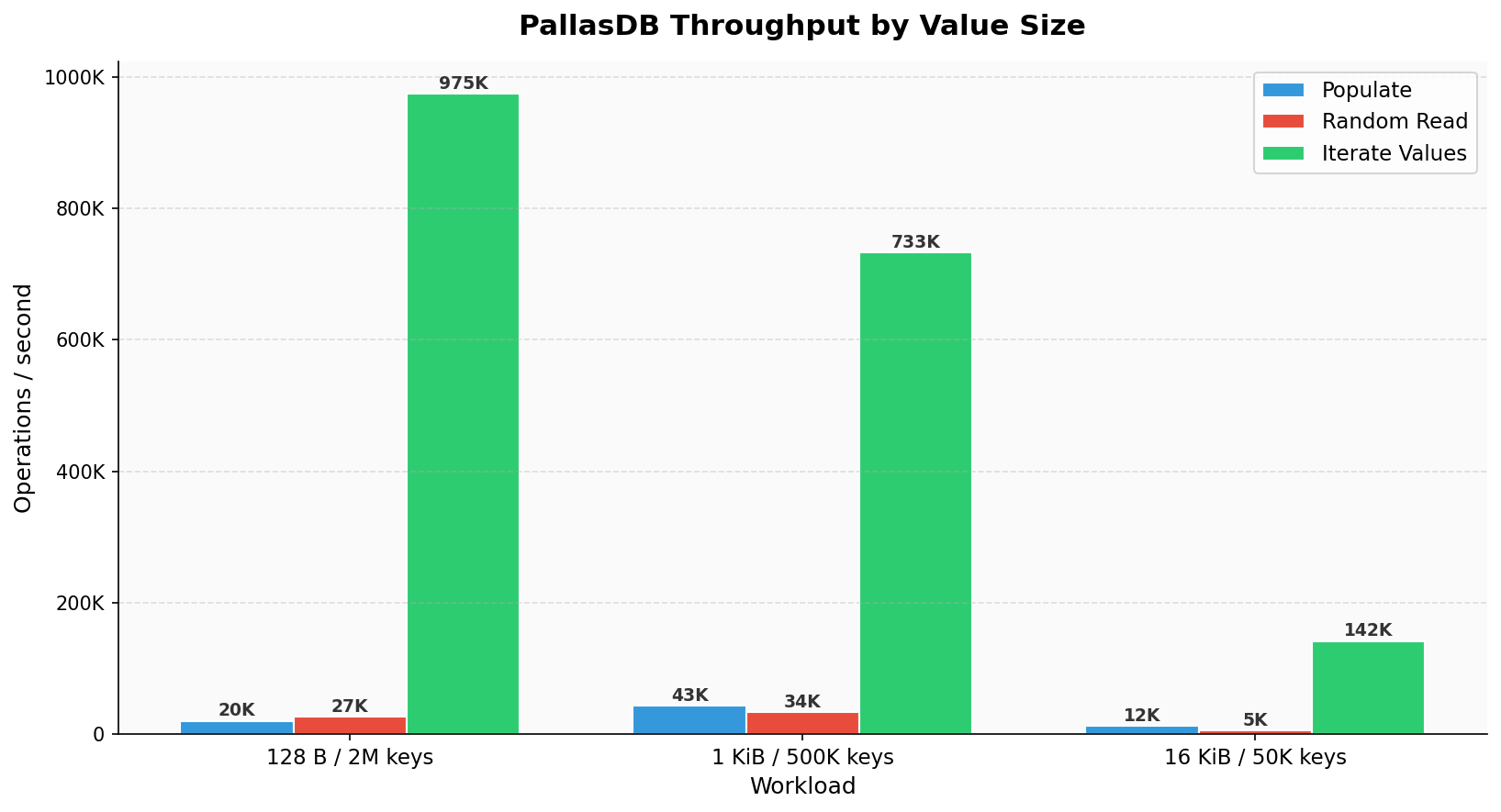
All runs reported missing: 0 and errors: 0.
Benchmark phases
Each benchmark run executes the following sequential phases:

Detailed results
128-byte values, 2 million keys
populate:      19,993 ops/sec  (1m40s total)
compact:       12.7s
reopen:        890 µs
random_read:   26,588 ops/sec  (18.8s for 500k reads)
iterate_keys:  1,014,357 ops/sec
iterate_values: 974,720 ops/sec
data_dir_size: 324,396,366 bytes (~309 MiB)
1 KiB values, 500k keys
populate:      43,362 ops/sec  (11.5s total)
compact:       5.6s
reopen:        425 µs
random_read:   33,529 ops/sec  (8.9s for 300k reads)
iterate_keys:  911,829 ops/sec
iterate_values: 732,912 ops/sec
data_dir_size: 529,099,166 bytes (~505 MiB)
16 KiB values, 50k keys
populate:      12,281 ops/sec  (4.1s total)
compact:       3.7s
reopen:        222 µs
random_read:   5,364 ops/sec   (18.6s for 100k reads)
iterate_keys:  322,315 ops/sec
iterate_values: 141,650 ops/sec
data_dir_size: 820,910,006 bytes (~783 MiB)
Performance optimizations (2026-06-03)
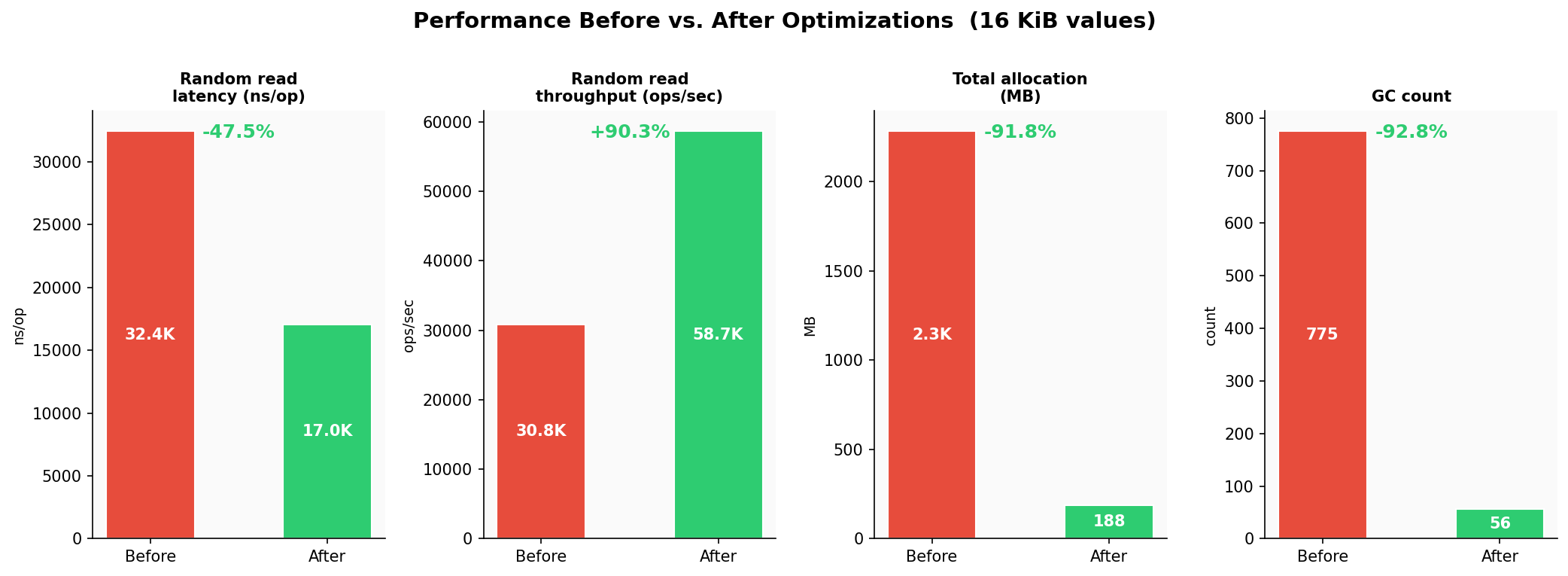
Two optimizations were applied after the initial benchmark run, resulting in significant improvements for large-value workloads:
1. Binary search key-only reads
Previously, compareKeyAt read both key and value bytes during binary search. The fix reads only the key during comparison, fetching the value separately only after the binary search confirms a match.
2. Fast-path append for ordered writes
When a transaction's updates are ordered after all existing memtable keys and no concurrent transactions are open, the commit appends directly to the memtable slices instead of performing a full merge. This eliminates O(n) work for sequential-key batch inserts.
Before vs. after (16 KiB values):
Running benchmarks
Smoke test (fast verification)
go run ./cmd/pallasdb local benchmark \
  --data-dir /tmp/smoke \
  --reset --keys 20000 --value-size 128 \
  --batch-size 500 --read-ops 20000 \
  --scan-limit 20000 --compact \
  --format text
Full scaled benchmark
go run ./cmd/pallasdb local benchmark \
  --data-dir /tmp/bench-v128 \
  --reset --keys 2000000 --value-size 128 \
  --batch-size 1000 --read-ops 500000 \
  --compact --format text \
  --output benchmarks/results.txt
Verifying the benchmark implementation
go test ./cmd/pallasdb -run 'TestLocalBenchmark'
go test ./db ./cmd/pallasdb
Environment
All recorded results were produced on:
| Field | Value |
|---|---|
| Hardware | Apple M4 MacBook Air |
| OS | darwin/arm64 |
| Go version | go1.26.3 |
| GOMAXPROCS | 10 |
| CPUs | 10 |