Cluster & Raft
Source: cluster/node.go, cluster/fsm.go, cluster/fsm_snapshot.go, cluster/command.go, cluster/discovery/serf.go
PallasDB's cluster mode provides strongly-consistent replicated writes using the HashiCorp Raft library. Member discovery uses Serf gossip.
Architecture
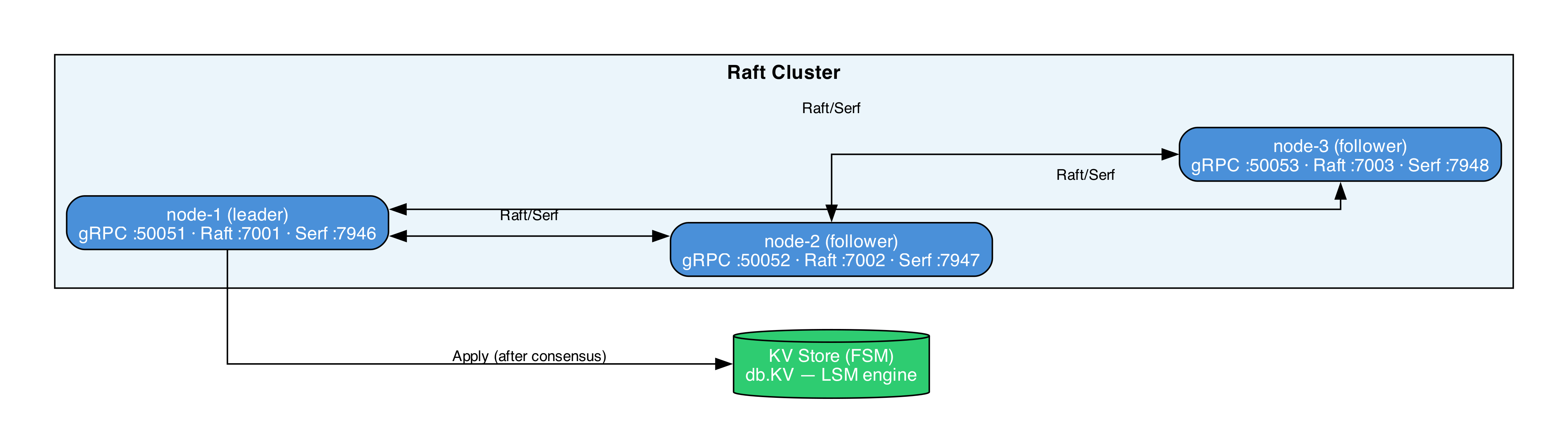
All mutating writes (Put, Delete) go through the Raft leader. Reads can be served locally from any node's FSM state (eventual consistency for reads, strong consistency for writes).
Node lifecycle
cluster.Open(kvStore, cfg)
- Creates the Raft data directory (
cfg.RaftDir). - Configures the Raft instance with
cfg.NodeIDas the local server ID. - Opens a TCP transport on
cfg.RaftAddr. - Opens a BoltDB store at
cfg.RaftDir/raft.db(with a 5-second file lock timeout to avoid blocking on a crashed predecessor). - Creates a file-based snapshot store (keeps 2 snapshots).
- Creates the FSM wrapping
kvStore. - Starts the
raft.Raftinstance. - If
cfg.Bootstrap=true, bootstraps the cluster with this node as the sole voter. - If
cfg.SerfEnabled=true, starts Serf and begins handling discovery events. - If
cfg.JoinAddr != "", sends a gRPCJoinrequest to the existing cluster.
Node.Shutdown()
- Stops Serf (if enabled).
- Shuts down the Raft instance.
- Closes the TCP transport.
- Closes the BoltDB store.
Finite State Machine (FSM)
FSM implements raft.FSM and wraps *db.KV with a sync.RWMutex to allow atomic state replacement during Restore.
Apply(log *raft.Log) interface{}
Called by Raft after a log entry is committed to a quorum. The entry is decoded as a Command:
type Command struct {
    Op   OpType      // OpPut or OpDel
    Key  []byte
    Val  []byte
    Mode uint8       // maps to db.UpdateMode
}
OpPut→store.SetEx(key, val, mode)OpDel→store.Del(key)
Returns *FSMResult{Updated: bool, Err: error}. The caller (cluster gRPC server) surfaces the error to the client.
Snapshot() (raft.FSMSnapshot, error)
Calls store.IterAll() to get a consistent point-in-time iterator. The iterator and its cleanup function are passed to FSMSnapshot, which streams all key-value pairs to the snapshot sink.
Restore(rc io.ReadCloser) error
Atomically replaces the entire FSM state:
- Reads all
(key, val)pairs from the snapshot stream. - Opens a fresh
db.KVat a temp directory (dirpath + ".restore"). - Writes all pairs to the fresh store.
- Under
f.mu.Lock():- Closes the existing store.
- Removes the old data directory.
- Renames the temp directory to
dirpath. - Opens a new
db.KVfromdirpath.
- The entire directory swap is the atomic unit.
Serf discovery
cluster/discovery/serf.go wraps the Serf library for automatic peer discovery:
type Config struct {
    NodeID            string
    GRPCAddr          string  // advertised in member metadata
    RaftAddr          string  // advertised in member metadata
    SerfAddr          string  // bind address
    SerfAdvertiseAddr string  // for NAT traversal
    JoinAddrs         []string
    EventBuffer       int
}
Each Serf member advertises its NodeID, GRPCAddr, and RaftAddr as member tags.
When a EventMemberJoin or EventMemberUpdate event is received and this node is the Raft leader, Node.addDiscoveredVoter calls n.raft.AddVoter(member.NodeID, member.RaftAddr). This means new nodes can join a cluster automatically without knowing the leader's address - they only need to know any existing Serf member's address.
SerfDiscovery.Members()
Returns []NodeInfo with the current known members, their gRPC and Raft addresses, and their Serf status.
Join via gRPC
When cfg.JoinAddr is set (and Serf is not handling join automatically), a gRPC Join request is sent to the target:
client.Join(ctx, &pbv1.JoinRequest{NodeId: nodeID, RaftAddr: raftAddr})
The target calls node.AddVoter(nodeID, raftAddr) on the Raft leader. If the target is not the leader, the Join call will still work as long as the target can forward or the caller retries.
Write path in cluster mode
The cluster gRPC server (grpc/cluster_server.go) intercepts Put and Delete:
- Encodes the operation as a
Command. - Calls
raft.Apply(encodedCommand, timeout). - Waits for the future to resolve (consensus reached and FSM applied on the leader).
- Extracts
*FSMResultfrom the future's response. - Returns the result to the caller.
If the node is not the leader, raft.ErrNotLeader is returned and the client should retry against the leader.
Configuration reference
| Field | Default | Description |
|---|---|---|
NodeID | required | Unique identifier for this node |
GRPCAddr | required | gRPC listen address, advertised via Serf |
RaftAddr | required | Raft TCP transport address |
RaftDir | required | Directory for BoltDB and snapshots |
Bootstrap | false | Bootstrap this node as the first in the cluster |
JoinAddr | "" | gRPC address of an existing node to join |
Timeout | 10s | Raft apply timeout |
SerfEnabled | true | Start Serf gossip for automatic discovery |
SerfAddr | :7946 | Serf bind address |
SerfAdvertiseAddr | "" | Serf advertise address (NAT) |
SerfJoinAddrs | [] | Serf addresses of existing members |
SerfEventBuffer | 64 | Serf event channel capacity |